
China sailed through the crisis in the Strait of Hormuz relatively unscathed even as the impact of its steps shielded other consuming nations from having to pay high crude oil prices.
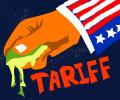
United States President Donald Trump on Friday announced that his administration will impose a 100 per cent tariff on branded and patented pharmaceutical products beginning October 1, 2025, unless the manufacturing companies are building production facilities in the US.

China's population growth has been slowing since 2016 as the high cost of raising children, a greater pursuit of individualism and a diversified lifestyle dampen enthusiasm to start a family.

China on Thursday announced that it would radically reform its gross domestic product calculation methodology and statistics release, to make it at par with international standards.
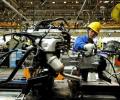
Exports have been a drag on the economy for some time as shipments have declined on weak external demand.
An economic superpower, China is marching ahead to become the world's largest economy.
China's economy will maintain its rapid growth next year though the government may face greater difficulties in macro-economic control, a top official of the National Bureau of Statistics said.
It was higher than 3.2 per cent rate registered in February, the lowest pace recorded in 20 months, state run Xinhua reported.
China's population in 2022 -- 1.4118 billion -- fell by 850,000 from 2021, the National Bureau of Statistics (NBS) said.

Industrial profit in China rose to 55 per cent in the first eight months of this year, according to new official figures released by the Chinese National Bureau of Statistics (NBS).
The first-quarter growth exceeded market estimates of 7.3 per cent, China's National Bureau of Statistics said on Wednesday.

Prospects of China hiking interest rates increased as inflation rose to 3.1 per cent in May, surpassing the government target of 3 per cent.

China grew by 9.7 per cent in the first quarter of this calendar year while inflation sped to its 32-month high of 5.4 per cent, according to the data released by National Bureau of Statistics (NBS).

The Chinese economy grew by stunning 10.7 per cent in the fourth quarter of 2009, which may see it replacing Japan as the second largest economy in the world.
China's car output had surged by 83 per cent to 2.02 million units in 2003.
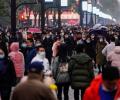
The population is important and so is the talent, he said about China, the world's second-largest economy after the United States.
China's demographic problem due to ageing population is showing up as the labour force for first time has decreased by 3.45 million last year, prompting officials to appeal to the new leadership to devise "appropriate and scientific" population policy.
The Gini coefficient, which reflects the wealth gap between rich and poor, was at 0.474 level for China in 2012 -- well above the warning levels, a report has said.
China's economy slowed down amid inflation concerns as its GDP growth rate slid to 9.5 per cent in the second quarter from 9.7 per cent in the first, while the economy in general expanded by 9.6 per cent in the first half of this year.
China's average GDP growth rate for the 1979-2004 period was on Monday revised to an impressive 9.6 per cent, 0.2 percentage point higher than the original figure in accordance with the first national economic survey.
China's gross domestic product soared to 13.65 trillion yuan ($1.65 trillion in 2004, an impressive growth of 9.5 per cent year on year, the government said in Beijing on Tuesday.

China's economy grew by 8.1 per cent in 2021 to about $18 trillion despite challenges, including epidemic resurgences and a complicated external environment, the government said on Monday. According to the official figures released by the National Bureau of Statistics (NBS), China's economy grew by four per cent in the fourth quarter of last year, slowing from the 4.9 per cent growth in the third quarter, rounding off the full year's growth rate to 8.1 per cent in 2021. The GDP increase is also above the six per cent target set by the government for the year.

Profits of major industrial firms slipped 5.4 per cent year-on-year to 366.8 billion yuan (about $59 billion) in July, the National Bureau of Statistics said in a statement.
Buoyed by record foreign trade, surging fixed investments and industrial production, China's GDP soared by an impressive 10.7 per cent in 2006.
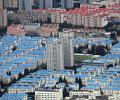
China's real estate investment rose 20.2 per cent in the first quarter from the same period a year earlier.
China's economic growth fell to 7.6 per cent year-on-year in the second quarter of 2012, from 8.1 percent in the first quarter, the slowest growth since first quarter of 2009.
Hit hard by a sharp drop in its trade surplus due to decreasing exports and rising inflation, China's GDP growth rate slowed to 9.1 per cent in the third quarter, the lowest since the fourth quarter of 2010, sparking concerns about a possible hard landing of its economy.
Buoyed by rapid growth in domestic consumption as well as exports, China's sizzling economy grew by 11.1 per cent in the first quarter this year though it raised concerns of overheating.
China's economic growth slowed down to 7.4 per cent year-on-year in the third quarter of 2012, slower from 7.6 percent in the second quarter and 8.1 percent in the first, the National Bureau of Statistics (NBS) said.
Over 23 million people were brought above the poverty line in China last year as about 100 million people from rural areas moved to cities for work.

To curb soaring inflation, the People's Bank of China, the country's central bank, has raised the benchmark interest rate three times this year.
China's inflation rate rose to 8.5 per cent in April, bouncing back to hover near 12-year highs, bringing more pressure on government to tame rising prices, identified by it as the "biggest concern".The Consumer Price Index (CPI), main gauge of inflation, rose 8.5 per cent from 8.3 per cent in March and remained close to a nearly 12-year monthly high of 8.7 per cent recorded in February, the National Bureau of Statistics said.

Overall, China's economy expanded at a rate of 11.1 percent on year-on-year basis during the first half of 2010.

The new data comes a day after China and the US signed a long-awaited phase one deal, marking a ceasefire in the 18-month-long trade war which saw the world's two largest economies slap 25 per cent tariffs on about half a trillion-dollar worth of each other's exports. The world's second-largest economy grew by 6.1 per cent last year, its worst performance since 1990, but it remained above the psychologically important mark of six per cent, according to the National Bureau of Statistics (NBS).

As China faces a scenario of negative population growth, the government has started to force its citizens to marry early and have at least three children each.
The manufacturing and construction sector accounted for 42.7 per cent of GDP while the farm sector accounted for 9.2 per cent.

With adoption of the new method the size of China's economy last year was about $130 billion larger than previously estimated.
China, the world's second largest economy, in a rare move on Monday lowered its GDP for 2012 by 0.1 percentage point to 7.7 per cent, the lowest in 14 years as the communist giant grapples with economic slowdown.
